Introduction
This article reflects the results of polling conducted by YouGov in August 2025 at the request of Dr Richard Johnson and the School of Politics and International Relations, Queen Mary, University of London (QMUL). Some of the following text has been written personally by Dr Johnson, with additional text provided by the Britain Unbound team.
Many polls have shown public dissatisfaction with Brexit. However, few polls ask about core beliefs about sovereignty (where policy decisions should be taken). A QMUL poll explored 20 policy areas previously under EU competence, and asked the public if they preferred those policies being decided at a national or supranational level. National preference dominated the responses. These findings provide a fresh perspective for UK policymaking outside the EU.
So what was the problem that I was looking to investigate, by undertaking this poll? Many public polls have shown public dissatisfaction with Brexit since 2020, and a decline in support for Leave since 2016. The conventional interpretation of these two data points is that voters regret leaving the EU, that there has been too much policy change from EU membership, and that voters desire to go back to the way things were. However the alternative explanation posited by some is that the British public are dissatisfied with Brexit because not much has changed since leaving the EU, and that successive Governments have failed to make noticeable use of the new policy levers now available to them outside of the EU. This poll looked to disambiguate the conventional and alternative interpretations, and instead provide insight into the actual sovereign desires of the British people disconnected from the emotional and polarised allegiance to one side of the debate or the other.
Methodology
I commissioned a YouGov survey in August 2025, which polled 4,534 GB adults about 20 policies, which had previously been partly or wholly competences under the EU. Respondents were asked, ‘Putting aside your views of the current government and thinking about UK governments in general, how do you think the following issues should be decided in Britain?’
- This policy should be decided by UK governments alone
- UK governments should voluntarily seek, but not be bound by, agreements with other countries on this policy
- UK governments should be required to follow decisions made by international institutions on this policy
- Don’t Know
The poll avoided asking about EU/Brexit directly. This is because as mentioned above, Brexit ‘tribes’ are powerful and polarise responses, obscuring underlying beliefs about sovereignty and policy.
Summarising The Findings
- The poll shows a strong majority instinct among the British public for the UK government alone being responsible for policy decisions.
- The UK government having powers ‘alone’ over the tested policies is not compatible with EU membership.
- Even when offered the choice of the UK government working with other countries or deciding these policies alone, respondents show a stronger preference to the UK government deciding these policies alone.
- Policymakers who think that the answer to public dissatisfaction with Brexit is to seek greater alignment with the EU and for the UK to be bound into more international agreements may be misinterpreting the public mood.
- An alternative theory is the British government has not sufficiently exercised these powers gained through Brexit, and public dissatisfaction may lie from a lack of new policy choices rather than from a failure to align more closely with the EU.
Segmented Findings Charts
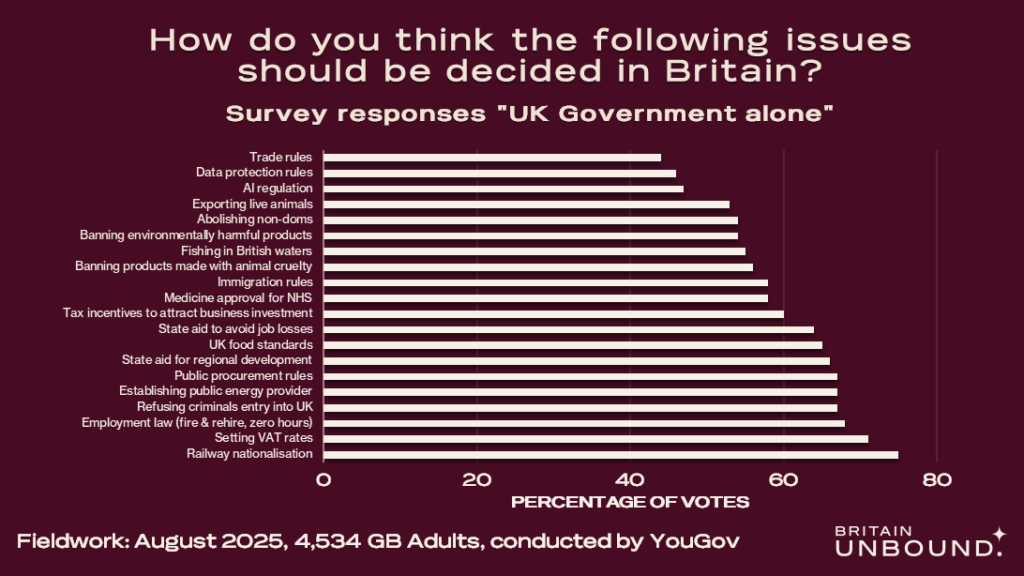
When all 4,500 respondents are taken together as whole, we see majority support for the UK Government alone retaining power to legislate in the 20 areas of competency included in the poll. This position is wholly incompatible with EU membership.
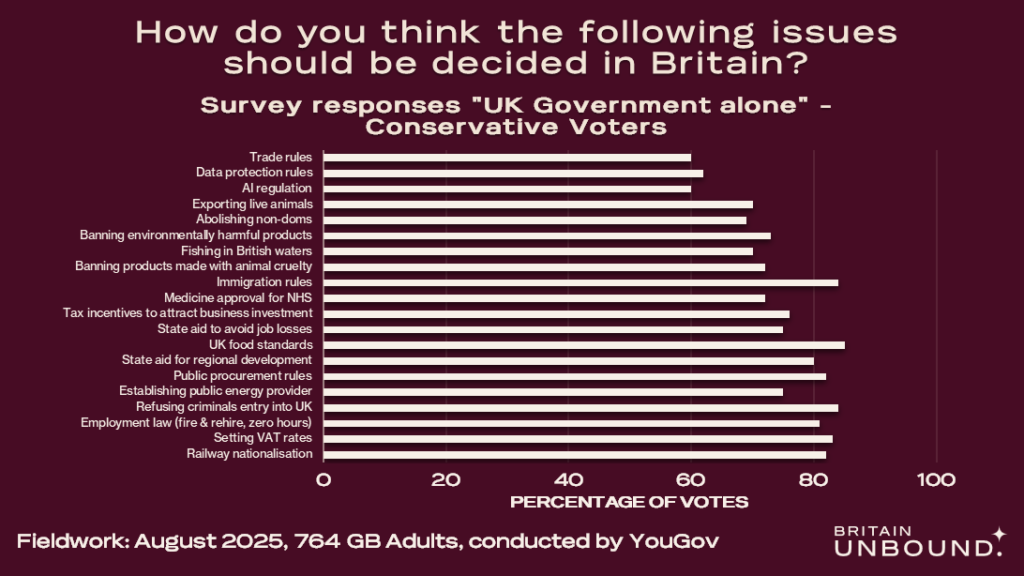
As will likely not be a surprise to many, the polling showed over 60% support on all 20 areas from Conservative supporting participants. The polling saw over 80% support for controlling immigration rules, along with UK food standards and refusing criminals entry to the UK
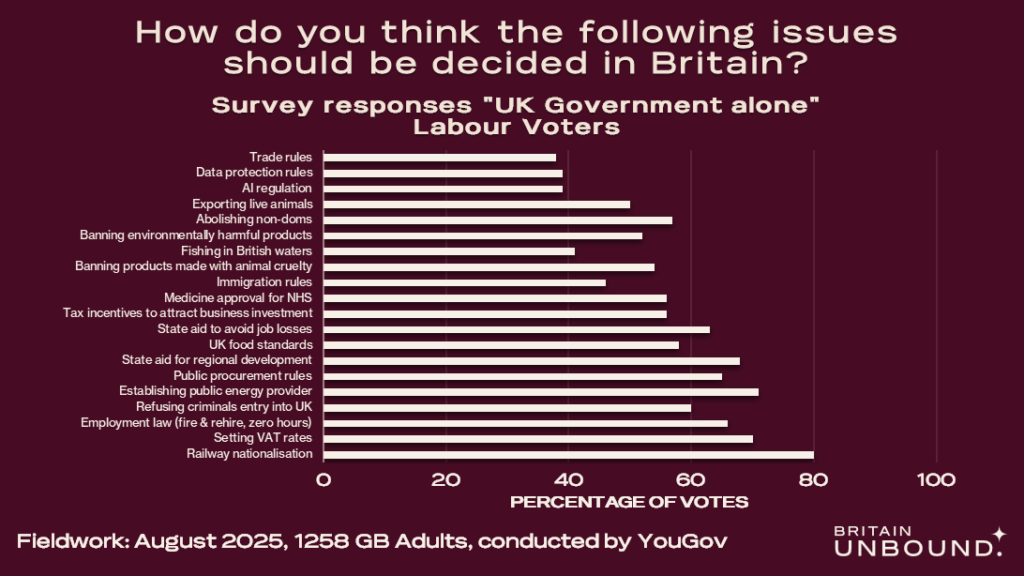
For Labour supporting participants, the polling saw a wider variance in response – but the option of the UK government alone was still the most popular for all 20 areas, and saw a majority in 15 of the 20 areas. Highest support was for railway renationalisation.
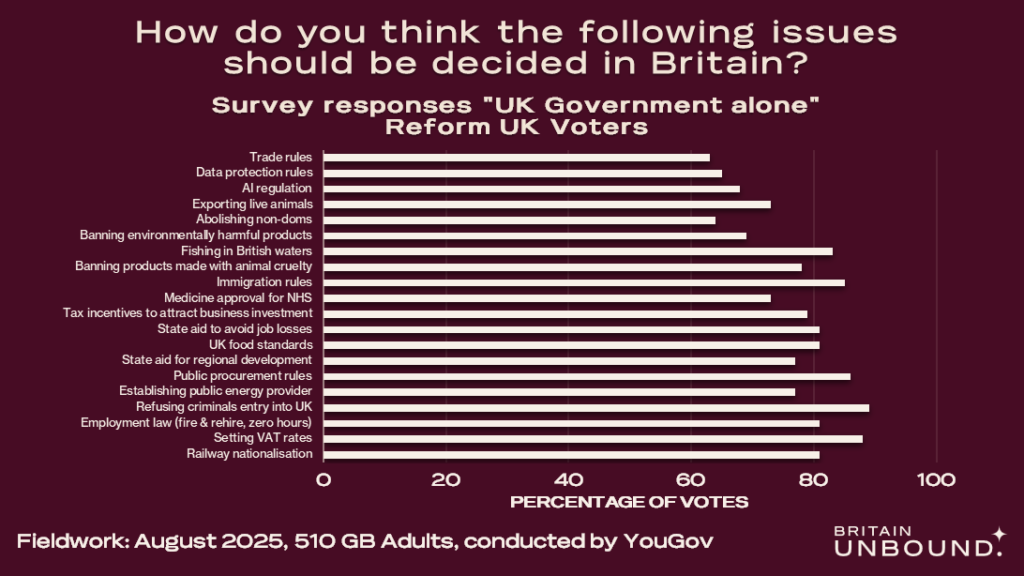
Also likely to not surprise many, the polling showed similarly strong support on all 20 areas from Reform UK supporting participants. Reform UK voters also showed over 80% support on areas of immigration, food standards, border control and setting VAT rules
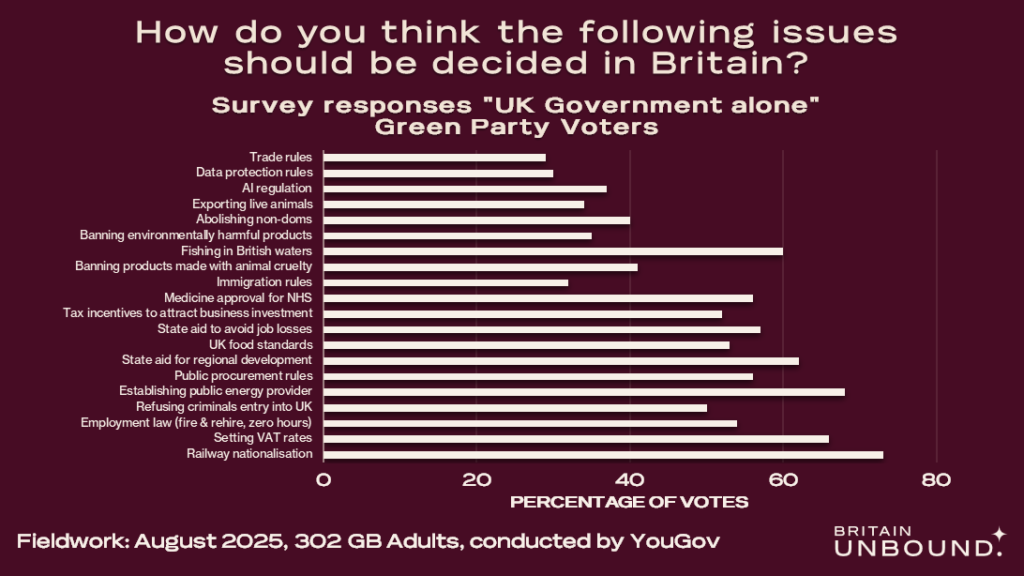
For the Green Party supporting participants – a party openly advocating for rejoining the EU – the option of the UK government alone was the most popular choice in 18 of the 20 areas. BUT in those 2 areas, the preferred choice was NOT EU control.
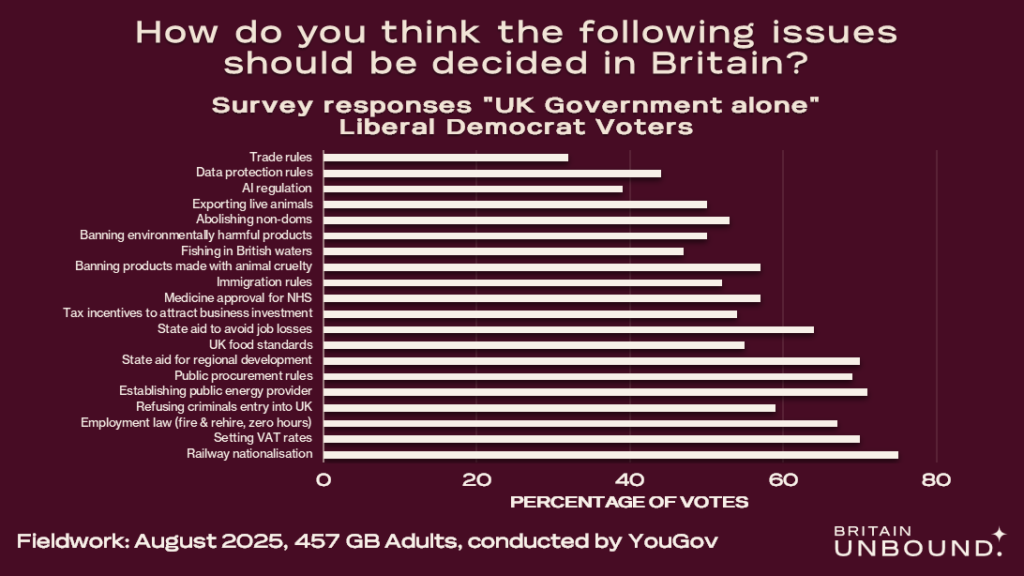
Finally on the party political divides, we have the data for the Liberal Democrat supporters. Again we see that the UK government alone being in control of policy, is the most popular choice in 19 of the 20 areas – with one remaining also not opting for EU control.
Links
- Johnson, R., (2026), “What does the British public think about sovereignty?”, Queen Mary Policy Briefs, Queen Mary, University of London – Click Here to Read
- The underlying data from the polling, as available on the YouGov website
- Interview for Podcast “Take Me Home”, 12th December 2025 – Click Here to View