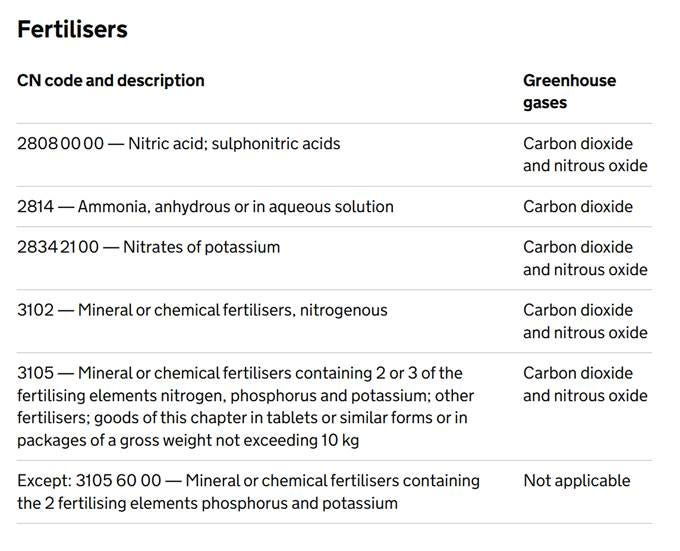
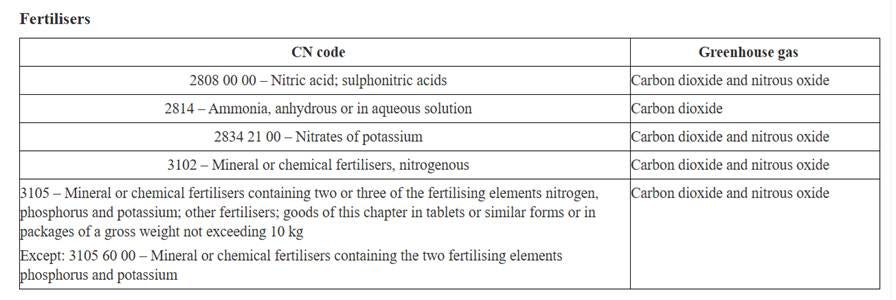
The latest UK CBAM proposal covers imports of the fertilisers: Nitric acid: Sulphonitric acids; Ammonia, anhydrous or in aqueous solution; Nitrates of potassium; Mineral or chemical fertilisers, nitrogenous; Mineral or chemical fertilisers containing 3 of the fertilising elements nitrogen, phosphorus and potassium; and Mineral or chemical fertilisers containing 2 fertilising elements.3 Exactly the same 8-digit HS code products as the EU.4
However, the UK produces less than 30% of the fertiliser it uses each year, but even this production relies on imported raw ingredients, most importantly, ammonia.5 CF Fertilisers’ Billingham plant ceased ammonia production permanently in July 2023 after being temporarily idled in August 2022. This was the UK’s last major ammonia producer. Adding a CBAM to imported ammonia and imported Nitric acid made from it, would increase costs for UK fertiliser mixers, which would be passed on to farmers and eventually raise the price of domestically produced food.
It is also strange that Sulphonitric acids, Nitrates of Potassium and mineral or chemical fertilisers containing either 2 or 3 fertilising elements are on the UK’s CBAM list of products in scope, as they are not currently produced on a large scale in the UK. Fertilisers containing 2 or 3 fertilising elements used to be made at the CF Fertilisers Ince site, which closed in 2022. Adding a CBAM to imported products when there is no alternative domestic supplier will necessarily increase agricultural production prices. Why is the government proposing to do this?
Compared to 2000, UK fertiliser output has halved, and the product mix has shifted away from broad-spectrum fertilisers toward nitrogen-only and imported blends, driven by plant closures, energy costs, environmental regulation, and global market restructuring.6 UK fertiliser use has fallen by 19.3% in the ten years up to 2024.7
CF Fertilisers closed its plant in Ince, Cheshire, in 2022, when European gas prices spiked.8 Fertiliser production is gas-intensive, so fertiliser production has moved to regions with cheaper gas. UK ETS allowances, as well as strict nitrogen-emissions regulations, have made domestic fertiliser production less competitive with imported fertiliser. The CF Fertiliser plant was one of the dominant industries in Ince, employing hundreds of people directly and many more indirectly.9
Most fertilisers are made from ammonia (NH₃), which is in turn made from natural gas. It takes about 0.9 tonnes of natural gas (methane, CH4) to produce 1 tonne of ammonia. The process requires high temperatures (400–500°C) and pressures (>100 bar), typically generated by coal or gas combustion, although it can also be powered by electricity. Conventional production emits about 2–3 tonnes of CO₂ per tonne of nitrogen fertiliser, plus nitrous oxide (N₂O) emissions from nitric acid production, which can add another 0.2–2 tonnes of CO₂-Equivalent (CO2e) per tonne, depending on abatement technology.
In the UK, fertiliser use typically increases arable crop yields by 30–50% and grassland productivity by 40–60% compared to unfertilised systems. Without fertiliser, most soils cannot supply sufficient nitrogen, phosphate, and potash to sustain high yields; therefore, fertiliser is critical for both food security and livestock forage production.10 Making fertiliser more expensive than it needs to be by adding an ETS on production or a CBAM on imports makes UK-produced foods more expensive.
Fertiliser production is emissions-intensive, and fertilisers are applied annually to land; therefore, it could be argued that it is appropriate to include a CBAM on imported fertilisers, but this would require UK farmers to have an alternative domestic supplier that is competitive in all respects except the cost of ETS allowances.
However, only nitrogen fertiliser production remains in the UK; the government could argue that it seeks to protect this remaining production by applying a CBAM to imported nitrogen fertilisers, but then why is it also adding a CBAM to imported ammonia, which is needed to make nitrogen fertilisers in the UK?
In 2024, the UK imported 3.22 million tonnes of the fertiliser products that will be covered by the latest update to the UK’s proposed CBAM.11 Almost all of which will be charged for both their CO2 and their nitrous oxide emissions. Making the CBAM doubly expensive.