This note takes a closer look at the government's claim that the UK-EU 'reset' will lift UK GDP by 0.5% in the long run. (Spoiler: it won’t...)
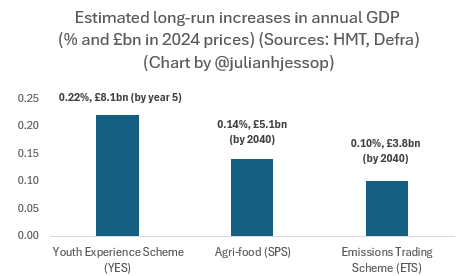
The 0.5% figure is broken down as shown in the chart below. The three individual figures add to 0.46%, which the Treasury has rounded up (not unreasonably) to 0.5%. This would be about £17 billion a year in 2024 prices, but it will take many years for the full effects to be felt.
The Youth Experience Scheme
The biggest component is the 0.22% for the Youth Experience Scheme. This is higher than the previous estimate and the main reason why the headline number is now 0.5% rather than the 0.4% that had been touted in the run up to the Summit.
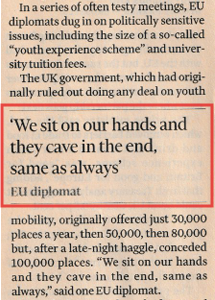
But this in turn is because the UK has caved to EU demands for a higher ceiling on the numbers of places on the scheme (summed up in this glorious quote in Saturdays’ FT). It is not obvious why the government would want to trumpet that.
Moreover, the methodology note confirms that the boost is driven by the assumption that the (unbalanced) mobility scheme will increase net immigration to the UK. In GDP per capita terms the impact is 0.0%.
Yes, zero.
But even this estimate is still too high.
As with the other elements, the assessment has ignored any costs that will be associated with the youth experience scheme, including the separate (but clearly related) agreement still to be done on tuition fees for EU students.
Of course, there may still be some social benefits from a youth mobility scheme which are not readily quantifiable in GDP terms. But these benefits can be achieved through more balanced bilateral agreements, such as those the UK already has with Australia and New Zealand and was seeking to negotiate with Germany, France and Spain, before the EU itself put a stop to that.
The agri-food (SPS) agreement
The second biggest contribution comes from the agri-food deal to align Sanitary and Phytosanitary (SPS) rules.
Here the methodology note shows that the assumed 0.14% boost is derived from economic modelling of the benefits of lowering non-tariff barriers – in this case, less paperwork and border checks – for both exports and imports.
To be precise, it uses a Computable General Equilibrium (CGE) model developed by Purdue University, also known as a Global Trade Analysis Project (GTAP) model.
This is fine as far as it goes, but it is just a model and both the assumptions and the results are open to interpretation.
For example, the modelling assumes that there will be a bigger reduction in non-tariff barriers for UK imports from the EU than for UK exports to the EU.
This could still be positive for UK GDP if it lowers prices of food and allows more spending on other goods and services. But a larger boost to imports than exports might also replace UK production and reduce GDP.
The biggest problem, though, is that this estimate looks only at the reduction in non-tariff barriers to trade between the UK and the EU, while ignoring everything else.
In particular, the SPS deal will impose additional costs and regulations on every farm and food business, even those that do not export to the EU, offsetting any benefits for the small number that do. Moreover, the requirement to 'dynamically align' with the EU rules means that the UK will have no real say in determining our own food and animal weflare standards.
The estimates also take no account of any financial contributions that the UK government will have to make to the running of the SPS scheme.
Finally, the deal adds very little because the UK can already reduce barriers to allow cheaper imports of food (and other goods) both from the EU and, thanks to Brexit, from the rest of the world. These freedoms will be lost if we are forced to realign with EU rules and tariffs.
The Emissions Trading Scheme (ETS)
The third contribution to the 0.5% figure, and the smallest, is the boost of 0.1% from aligning with the EU’s Emissions Trading Scheme (ETS).
The methodology note here essentially just assumes that the cost of carbon will be lower in the EU scheme than it would have been in the existing UK scheme. That is possible (the EU ETS is a larger, more liquid market), but far from certain.
Indeed, carbon prices have been higher in the EU scheme for many years and have actually risen under the UK ETS in anticipation of this agreement. For the foreseeable future, then, this element of the deal will increase energy prices and the cost of living.
And once again, the modelling here makes no allowance for any potential costs – notably those resulting from the interaction of the ETS with the EU’s Carbon Border Adjustment Mechanism (CBAM).
This is simply flagged as a “potential sensitivity”, though the note does at least acknowledge that “exemption from the EU CBAM would have further growth benefits” (an admission that closer alignment here could actually lower growth).
The net impact on GDP? Likely to be negative...
In summary, the assumed 0.5% boost to GDP from the 'reset' is highly speculative. Even on the official numbers, it is barely half that in per capita terms.
Moreover, once all the economic and financial costs are properly counted, the net impact of the deal is likely to be negative. Frankly, a reduction in GDP of 0.5% looks far more plausible than a 0.5% boost.
Rarely has so much control been given away – and so much political capital spent – in return for so very little.
Julian Jessop is an independent economist with nearly four decades of experience gained in the public sector, the City and consultancy, including stints at HM Treasury, HSBC, Standard Chartered Bank, and Capital Economics. He now works mainly with investment committees and with thinktanks, notably the Institute of Economic Affairs, and is a regular commentator in the media.
Julian has provided expert testimony to parliamentary select committees on many topics, including Brexit, and is well known around both Westminster and Whitehall. He has a First Class degree in Economics from Cambridge University and further qualifications in both economics and law.